ChatGPT-5, Claude 3.5, or Gemini? The Truth About AI Detection in 2026

ChatGPT-5, Claude 3.5, or Gemini? The Truth About AI Detection in 2026
Why the most important question isn’t which AI is hardest to detect—but why we keep asking the wrong question.
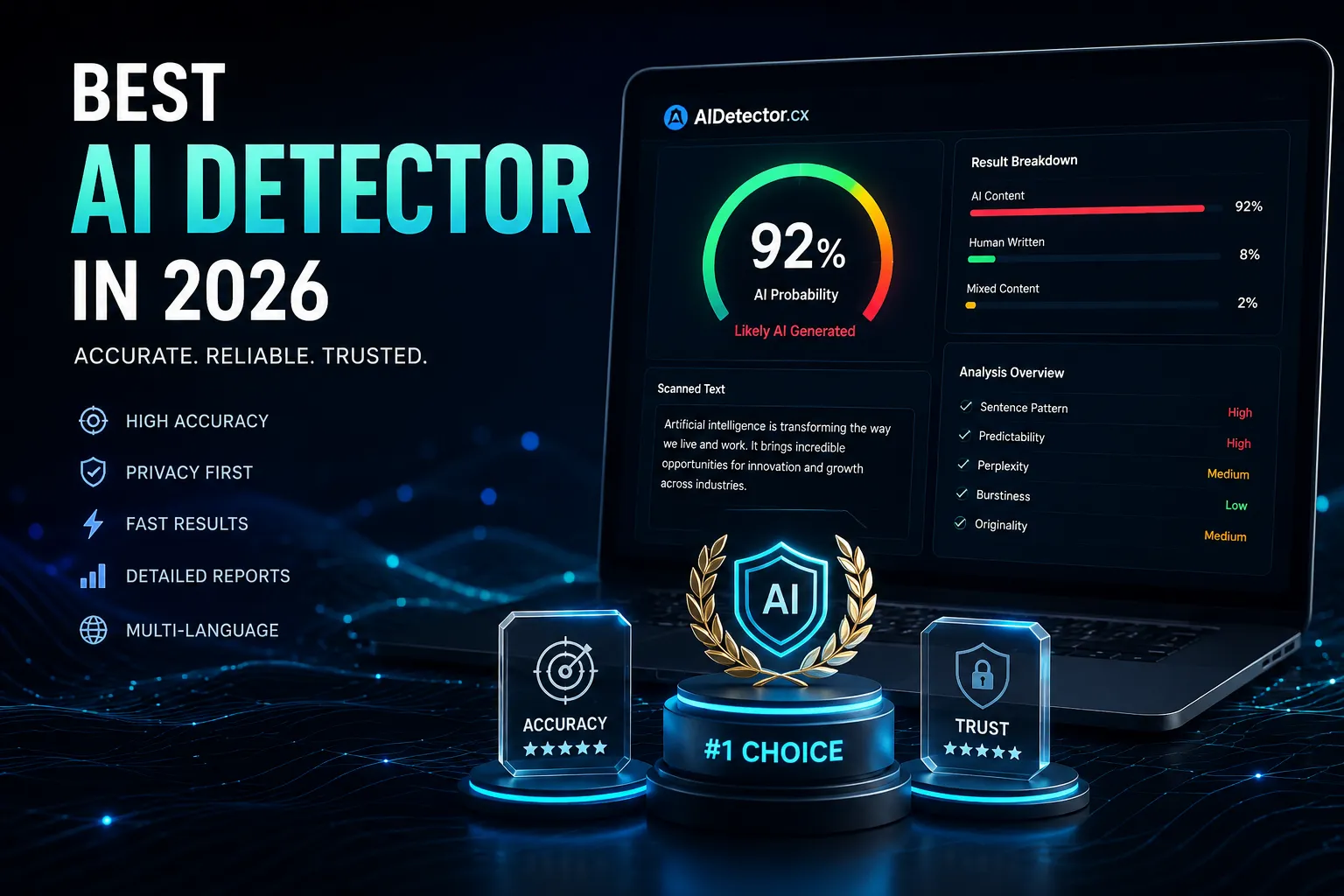
AI detection compares linguistic and statistical patterns rather than proving which language model created a passage.
How many times have you used any of the notable Language models; ChatGPT-5, Claude 3.5, or Gemini to generate content? If your answer is multiple times, then you are in for a ride, as this article aims to shed light on the judicious use of AI language models, and also how the emergence of AI detectors work.
The aim of this article is to show how users of the aforementioned Language models could adequately make use of AI to assist them, and still derive authentic/ original human based content.
There’s no doubt that Artificial Intelligence has significantly transformed the way content is being generated. Prior to now, to generate content took a lot of effort; drafting, reviewing, editing, proofreading and other things involved, and this subsequently bought into time that was used in generating content. However in recent times, depending on whatever field you find yourself one could generate content easily and efficiently within minutes as opposed to the longer time period of generating content before. With that in view it is pertinent to mention that the evolution of AI systems has without doubt become an inevitable companion of every professional in modern times.
In recent times, there are few notable language models; ChatGPT-5, Claude 3.5, and Gemini. They have consequently bagged a reputation for producing fluent , factual and human - like text. As these models keep evolving and improving their capabilities, they are increasingly making it difficult to distinguish between Ai generated content and human generated content.
The adoption of AI systems has contributed immensely with our content being generated by professionals. The rapid adoption of AI systems has also paved the way for a new AI technology; AI Detection. Most Schools, Employers, and Businesses owners are beginning to embrace the use of AI Detection, to assess and review if students or employees works are human generated or machine generated. This has recently sparked a controversial question as to which of the language models is the most difficult to detect amongst; ChatGPT-5, Claude 3.5, or Gemini?
As much as this is an interesting question, it is still not the right question to be asked, because these models are a fraction of AI systems, and what writers and professionals need to understand is how AI Detectors works.
Understanding AI Detection
With the emergence of AI detectors doesn’t necessarily mean availability of digital lie detectors. The features of AI detectors does not include the ability to detect a watermark of the use of a specific language model, ChatCPT, Claude or Gemini. However they have the ability to check the probability of a text/content being either machine generated or human generated.
AI Detectors mostly carry out their evaluation based on certain features that help detect sentence predictability, content structure, writing style as well as punctuation accuracy. It is also important to note that most AI detectors evaluation are based on two concepts; perplexity which helps in checking the sentence structure and consistency and business, this carries out its evaluation by checking the length of the sentence.
One distinctive feature that makes human written content stand out is the like of consistency. While what most human written content has in common, is lack of trajectory flow, interjections in thought process which reveals itself in final content, and use of repetitive phrases/ sentences. On the other hand,machine generated content has a systematic approach, which includes detailed consistency, good writing style and punctuation accuracy, are features that would most likely make AI detector systems to flag down most human written content.
It is pertinent to consider that these evaluations are based on statistical analysis and not 100% accurate, as most AI detectors systems cannot entirely detect who wrote a particular document. They rather conduct their analysis based on observable writing styles.
Meet the Contenders: ChatGPT-5, Claude 3.5, and Gemini
In recent times, the use of the following language models; ChatGPT-5, Claude 3.5 and Gemini have made content writing more accessible and easier for professionals. Each of these language model has it unique features that makes it stand out, and also contribute to the controversial argument as regards to which one of them is the most efficient and would be the most difficult to be detected, but before we dive into that conversation it is essential to understand the concept and features of the aforementioned language models.
Starting off strong, we have ChapGPT, this particular is on the lips of most researchers, students and professionals. That’s because it has stood the test of time, and also offers a range of concepts, which includes content writing, ideas generation and coding assistance and it always delivers clear and accurate information if prompted well.
On the other hand we have Claude 3.5, this particular language model as opposed to earlier AI language has established itself on the basis of creating more controversial, relatable content that could most likely be mistaken for human generated content, because of how eloquent and complex it’s final product comes out.
Last on the agenda, would be Gemini. This seems to be more different from the rest based on its allegiance with the Google ecosystem. However unlike other AI language models that produce results independently, so far as they are prompted well, it’s not the same case with Gemini, as depends strongly on a series of instructions and assistance to generate a good result, and upon which your content isn’t not guaranteed to be coherent at the end of the day.
It is very essential to note that all these AI Language models aim at one particular end goal, which is to generate content that could easily pass off as human generated content.
So, Which AI Is Actually Hardest to Detect?
The long awaited response is finally here, but before I give my verdict, I would like to know your opinion.
The answer to the long wait question might not necessarily interest everyone. However I would advise you to read further to get a better grasp of how an AI detector actually works.
Alas, the answer to the controversial question is that none of the language models has been detected to be stronger or more difficult to detect than others.
That being said, I know most readers would have expected the answer to be ChatGPT, but here is why that answer is not entirely right. When content derived from ChatGPT is uploaded on an AI detector system, the result might show a slim chance of being AI generated content, whereas if it’s uploaded on another AI detector system the answer might show a higher percentage as opposed to the first, the same evaluation process applies to both Claude 3.5, and Gemini.
The reason behind this incoherence, would be that the concept adopted by most AI detector systems varies, as they are programmed to determine “AI like content” and also the algorithm, dataset, and language style varies from one company to another.
Like I mentioned above, I would really implore that you take your time and dissect the content of this article, because as opposed to asking which AI Language model is difficult to detect, I believe the right question to ask would be; How was the content created, edited, reviewed and refined before getting to the detecting stage?
And this question would lead us to another insightful sub topic.
Why AI Detectors Often Disagree
We’re slowly getting to the bone of contention, but before we arrive I would like to mention that there’s a general misunderstanding about how AI detectors work, as most professionals, researchers, students and others treat the verdict given by AI detectors to be 100% accurate, that’s not entirely correct, as AI detectors is not considered as a scientific instrument used to measure the entirety of AI generated content, but rather a tool that works based on how it has been programmed to detect AI generated content.
In order to understand the concept above, I would give a more relatable example that would help to shed more light on the matter on ground. Imagine a scenario whereby about three or more book critics are contracted to review an anonymous author’s work. Without anything being said, there are bound to be 3 different reviews, and this would be based on the concept each critic adopts. For instance critic one, might focus on writing style, while critic two might focus on sentence predictability/structure, while critic three might focus on vocabulary and punctuation accuracy. The fact that each critic adopted a different approach in reviewing the author’s work doesn’t mean that their final verdict / review is wrong or entirely correct. This same analogy applies to AI detector systems.
With the evolution of AI language models that keeps coming up, it shows that the system is still very much active and working towards being efficient and an aid to writers generating content. As AI language models keep evolving, so will measures also be put in place to checkmate the activities of AI language model, it is also important to note that AI detectors are not 100% accurate, and because a particular AI detector ranks a content as 18% AI generated, and another system ranks it as 34% does not necessarily mean there’s a loophole somewhere. It just shows that there are different metrics, algorithms and dataset integrated into the AI Detector system.
When Human Writing Gets Flagged
Like the saying goes, every good thing has to have a downside. That of AI detectors, occurs when they flag down a human generated content as being AI generated.
As stated in previous paragraphs, it is pertinent to understand the underlying concept of AI Detectors, which is that they do not give an accurate answer, but rather conduct their review with one major factor in mind; to detect AI-like content.
Most scholars, writers, researchers and students have overtime developed a more sophisticated writing style, which spans out in their final document. Bear in mind that what makes AI generated content unique is the ability to deliver coherent content. This factor is always checked and remains the basis upon which an AI Detector system would flag down a genuine and authentic generated content as machine or automated content.
That brings us down to the issue of false positives. False positives occur when human generated content would be misconstrued as machine generated content, based on the writing style, sentence predictability/structure, good use of eloquent vocabulary as well as other factors. Which AI Detectors sometimes mistake as proof for machine generated content.
On that basis, it is important to note that as much as AI detectors show strong signals or reviews as regards to AI generated content, their verdict should not be considered as the final proof /evidence to judge a professional content. Other factors should be considered, such as clear evidence of thorough research done should be reviewed upon conducting a final verdict on a professional’s work.
Like the saying goes, whatever has a beginning would definitely have an end. On that note my dearest gentle reader we’ve arrived at an end to our ongoing conversation. But bed I take a bow, I still need to give a final verdict on the aforementioned question; which is hardest to detect: ChatGPT-5, Claude 3.5, or Gemini?
But before that, we need to understand the dynamics between AI language models and AI detectors systems, as the two keep evolving, and as the society at large is becoming more digitalized, they are certainly here to stay, and would not be leaving the society anytime soon. It is very important that we understand how this two systems could collaborate together and drive immersive impact in the general outcome of our work/content.
The underlying factor behind the emergence of these systems is simple and clear; aiding productivity and driving efficiency amongst professionals. And with that in mind, we need to understand that the main issue is not how manipulate AI generated content, to fit into not being detected by AI Detectors systems, but rather how to inculcate the use of these language models to generate more authentic, coherent and organic content that would be enjoyed by a wider audience.
In a nutshell, the answer to the question is that professionals should incorporate the use of both Language models as well as AI detectors for a better use, as they both have a distinctive features/ characteristics that if incorporated into their work, the output would supersede whatever rating any AI Detector would give.
Recommended Tools
Stay ahead of AI detection trends
Get the latest guides, research, and product updates from AIDetector.cx delivered to your inbox.