How Simply Humanizer and Undetectable AI Attempt to Trick Scanners — And How to Spot Them

How Simply Humanizer and Undetectable AI Attempt to Trick Scanners — And How to Spot Them
What comes to your mind when you hear the word “Humanizer” ? Permit me to take a wild guess, you’re thinking something associated or affiliated with being human written or natural work/content written by a human being, as opposed to the influx of artificial writing or automated writing that has swamped up our modern day society.
With that being said, I might just be right to assume that there’s a current conquest in town, would you like to know the two top contenders. I would like to satisfy your curiosity by giving a clue. The conquests are greatly affiliated with the current evolution of artificial intelligence. If by chance, you guessed that the two top contenders are between AI generation and AI language, I would like to say that you’re close, and it would be only right that you give yourself a pat on the back for being close to the answer. If you by chance are among the few that guessed that the two top contenders are Simply Humanizers and Undetectable AI, then you would have to do me the honors of giving yourself a very big sound of applause, because you are right!!!!!
Without further delay, let’s dive straight into the topic for today. If you want to get a better understanding of how Simply Humanizer and Undetectable AI attempt to trick scanners, then you’re at the right spot. This article will dissect and shed extensive light on the above top contenders, and if you want to know which of the two would be leading/ topping the chart. You’ll definitely need to grab your seat, popcorn and a chilled drink, ( to step down all the information judiciously), as usual you’ll be in for a good time!!!!!
Understanding how Simply Humanizer, and AI Detector co-exist.
Simply Humanizer refers to the act of rewriting or restructuring AI generated content to make it more human-like, in order to be able to pass the AI Detector test.
Given that we have a proper understanding of what Humanizers are, it is pertinent to fully understand how it works.
With the influx of AI language models, most researchers, professionals have adopted the use of these tools to make work more easier and efficient. However, excessive use of these tools have made most universities supervisors/ superiors on the look out to confirm the authenticity of students/ professionals content, which brought about the rise of AI Detectors. These AI detectors have different variations and methodologies that they employ to carry out authenticity test to proof authorship for writers, and overtime there’s has been an argument surrounding the validity of these AI detectors, because we’ve seen cases of False positives; these occurs when human generated content are being mistaken for AI generated content, because of the sentence structure, writing style, punctuation accuracy and other analysis being considered by the particular AI Detector, we’ve also seen cases of False negatives; these occurs when AI generated content are being mistaken for human written content based on writing style, sentence structure, sentence length and other factors are being considered.
It is important we understand that the influx of AI Detectors, gave room for the rise of Humanizers, because most professionals after imploring the use of AI language models to generate content, they would seek for further means to make their content look more original, conversational and natural as opposed to their content looking like it was programmed or excessively structured, based on the writing style, sentence structure and punctuation accuracy as well as other factors.
Factors to look out for while verifying if a content has gone through Humanizer Systems
From our ongoing conversation, it is essential that we understand that no AI Detector has been scientifically proven, or has a final verdict to show authorship of content. AI Detectors are basically used to give clue/hint that a content was machine generated as opposed to human generated. That’s why till date, if you use various AI Detectors tools to conduct an evaluation on your content, they end up giving varying results; one might show 28% AI- like, while another shows 18% mixture (the mix of AI like and human generated content), while another might give 36% AI - like, all these are based on the fact that there are different methodologies, statistical analysis binding how each AI Detector operates.
Let’s dive into understanding how to detect when AI generated content has been “humanized “.
One thing to be on the look out for, is sentence structure, most AI language models content, already have a structure in which there sentence appear, and in order to make their content more human like, they tend to rephrase their sentences, and make it seem more inconsistent, just to try and manipulate the verdict any AI detectors would give.
Another indicator, would be that use of less ambiguous words, one thing about AI generated content is the constant use of highly polished and sophisticated languages in their sentences
AI Generated content;
The innovative algorithms that were disseminated, through Financial Analysis are quite cumbersome.
Human Generated Content;
Information shared during the meeting was very large.
Notice that the two sentences shared the same message, however the choice of words used in AI generated seems to be quite ambiguous, and also easy to detect that such content was generated by AI Language, this does not validate that human generated content can’t make use of such words, but it’s most likely be used by Al language models.
Another indicator would be the rephrasing of certain phrases, as well semantic phrases being used in sentences. There are certain phrases that upon first sight, you automatically associate them with AI Language models, they include;
“Furthermore”
“In addition to”
“In conclusion “
“Moving on”
“On that note”
It’s not safe to state that these phrases are only associated with AI language models, because some technical, sophisticated and articulated researchers might make use of such phrases, while generating their content.
What Undetectable AI Claims to Do
Undetectable AI is a platform that offers services ranging from AI dectector and text- humanization tools. They claim to offer a mixture of services that detect machine generated content, and also humanizing tools that help machine generated content look more human like, by invoking certain factors such as sentence structure, word rephrasing as well as adjusting the tone of sentences.
Simply Humanizer, on the other hand is a platform that aims to directly rewrite or restructure a content generated by AI Language models, to fit into human-like content.
However, I don’t think the bone of contention is to justify which of the platforms can be able to successfully trick/manipulate scanners from detecting if a content is generated by AI language models. But rather to understand the level of damage/impact each of these platforms have on the society at large.
How to Conduct a Fair Humanizer Test
A reliable credible comparison requires controlled conditions. Testing unrelated passages on different tools cannot establish which humanizer performs better.
Begin with one unedited AI-generated passage. Record its generating model, prompt, subject, word count, language, and creation date.
Process identical copies through each humanizer. Record every selected setting and preserve the complete outputs.
Then test the original and rewritten versions with the same detector versions.
Compare more than detector scores. Evaluate meaning preservation, readability, grammar, factual accuracy, citations, word count, and introduced errors.
Include a genuinely human-written control sample. This sample helps expose detectors or testing conditions that create false positives.
Do not declare a winner from one passage. Results should cover multiple subjects, document types, lengths, and source models.
Responsible Use of Humanizers
Humanizers can have legitimate purposes. They can help improve clarity, simplify technical language, adjust tone, or support non-native writers.
Those uses still require human review. Users remain responsible for facts, citations, originality, disclosure, and compliance with relevant rules.
Using a humanizer to conceal prohibited AI work creates a different ethical issue. A lower detector score does not transfer authorship to the user.
Universities and employers should publish clear AI policies. Those policies should distinguish permitted assistance, required disclosure, and prohibited substitution.
No disciplinary decision should depend entirely on an automated score. Drafts, notes, document history, citations, interviews, and earlier writing provide important context
How AIDetector.cx Approaches Humanized Text
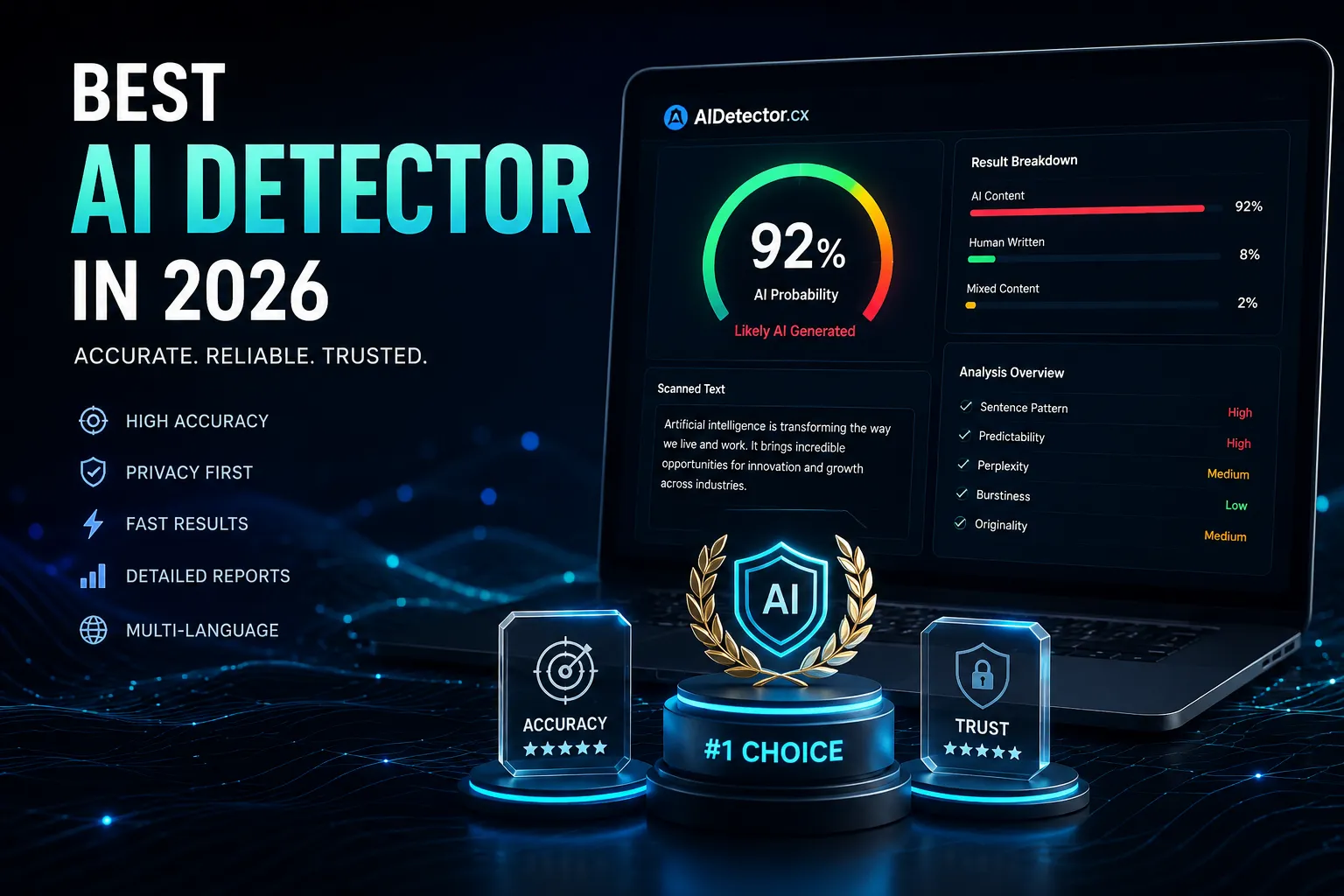
AIDetector.cx provides two detection views instead of hiding uncertainty behind one label.
Balanced Detection emphasizes reducing false positives. It requires stronger combined evidence before favouring an AI-generated interpretation.
Aggressive Detection examines weaker and less obvious AI-like patterns. It may identify residual patterns that remain after paraphrasing or humanization.
Higher sensitivity also increases the possibility of false positives. An Aggressive result should therefore trigger review, not an accusation.
When both modes agree strongly, the interpretation has broader model support. When they disagree, the disagreement itself becomes useful information.
Users should also examine AI, HUMAN, and MIXED probabilities, confidence, detected language, and flagged passages.
The result concerns visible linguistic patterns. It cannot reconstruct every tool, edit, translation, or person involved before submission.
Frequently Asked Questions
Can a Humanizer Guarantee That AI Text Becomes Undetectable?
No. Results vary across detectors, languages, models, settings, subjects, text lengths, and software updates.
Can Words Such as “Furthermore” Prove That Content Is AI-Generated?
No. Human writers use transitional words regularly. Repeated patterns across a complete passage may provide evidence, but one phrase proves nothing.
Does Humanizing AI Content Make It Original?
No. Rewriting does not establish authorship, factual accuracy, originality, or permission to reuse another person’s ideas.
Can an AI Detector Prove Academic Misconduct?
No. A detector evaluates text patterns. Misconduct requires policy context, supporting evidence, human review, and a fair opportunity for explanation.
Why Do AI Detectors Return Different Results?
They use different datasets, signals, thresholds, calibrations, and classification methods. Their results can also respond differently to paraphrasing and editing
We can all agree that the adoption of certain technology systems has no doubt made work more efficient, easier and stress- free. However, with the wave of certain systems creating room for others to thrive, and the cycle continues ongoing, take for instance the rise of AI Language models , brought about the evolution of AI Detectors, which most supervisors and superiors have adopted in order to verify authenticity of writers content. The evolution of AI detectors, subsequently gave room for the wave of Humanizers, which aims to manipulate and deflect the ability of AI detectors to give a verdict as to if a content is machine generated or human generated.
If I am reading your mind correctly, I would guess the main question on your mind would be; what would the emergence of “Humanizers” give rise to? But I don’t think that’s the right question to be asked. I strongly believe that the main focus should be on how to generate content that is readable, accessible and relevant to readers and users at large.
Recommended Tools
Stay ahead of AI detection trends
Get the latest guides, research, and product updates from AIDetector.cx delivered to your inbox.