
AI Detector for ChatGPT, AI & Human-Written Content
Detect AI-generated, human-written and mixed content across multiple languages with independent detection modes, sentence-level analysis and explainable results.
Creating content for search?
Go beyond AI detection with SEO scoring, plagiarism checks, content uniqueness, readability and publishing-readiness analysis.
Why Two AI Detection Modes?
AI detection is probabilistic — it estimates how likely a text is AI-generated, not whether it proves authorship. Different detection approaches can identify different signals, which is why running two independent modes gives you a more complete picture.
Balanced Detector
RecommendedCalibrated to balance AI detection sensitivity with reduced false-positive risk. Best for general-purpose detection where avoiding incorrectly flagging human writing matters.
High-Sensitivity Analysis
StrictDetects weaker AI-like patterns with higher sensitivity. This mode has a greater risk of flagging human-written text and should be interpreted alongside the Balanced result.
Multilingual AI Detection
Writing patterns vary significantly across languages, so a reliable multilingual AI detector must account for linguistic differences rather than applying identical English assumptions everywhere. AIDetector.cx analyzes text in its detected language using language-aware calibration, with explicit support status for each language.
Validated
Production-tested with higher confidence thresholds.
Beta
Functional and improving; accuracy may vary by genre.
Experimental
Early-stage support; use results as directional only.
Accuracy varies by language and status. The detector automatically reports the detected language and, where reliable, the regional variant. Mixed-language or code-switching text may be segmented and analyzed per language.
How Our AI Detector Works
From text to transparent, explainable analysis in four steps.
1. Add Your Text
Paste or upload supported content. The AI checker works with essays, articles, reports, emails, and more.
2. Analyze Writing Patterns
Multiple linguistic, structural, and statistical signals are examined across the full document in the detected language.
3. Run Independent Detection Modes
The Balanced and High-Sensitivity engines examine the text independently, each using its own calibration and thresholds.
4. Review Explainable Results
Review AI, human and mixed probabilities, detected language, sentence-level signals and a full detailed analysis on the detector page.
See how AIDetector.cx works
Watch a 60-second walkthrough of real text scanning, dual sensitivity modes, and transparent signal analysis.
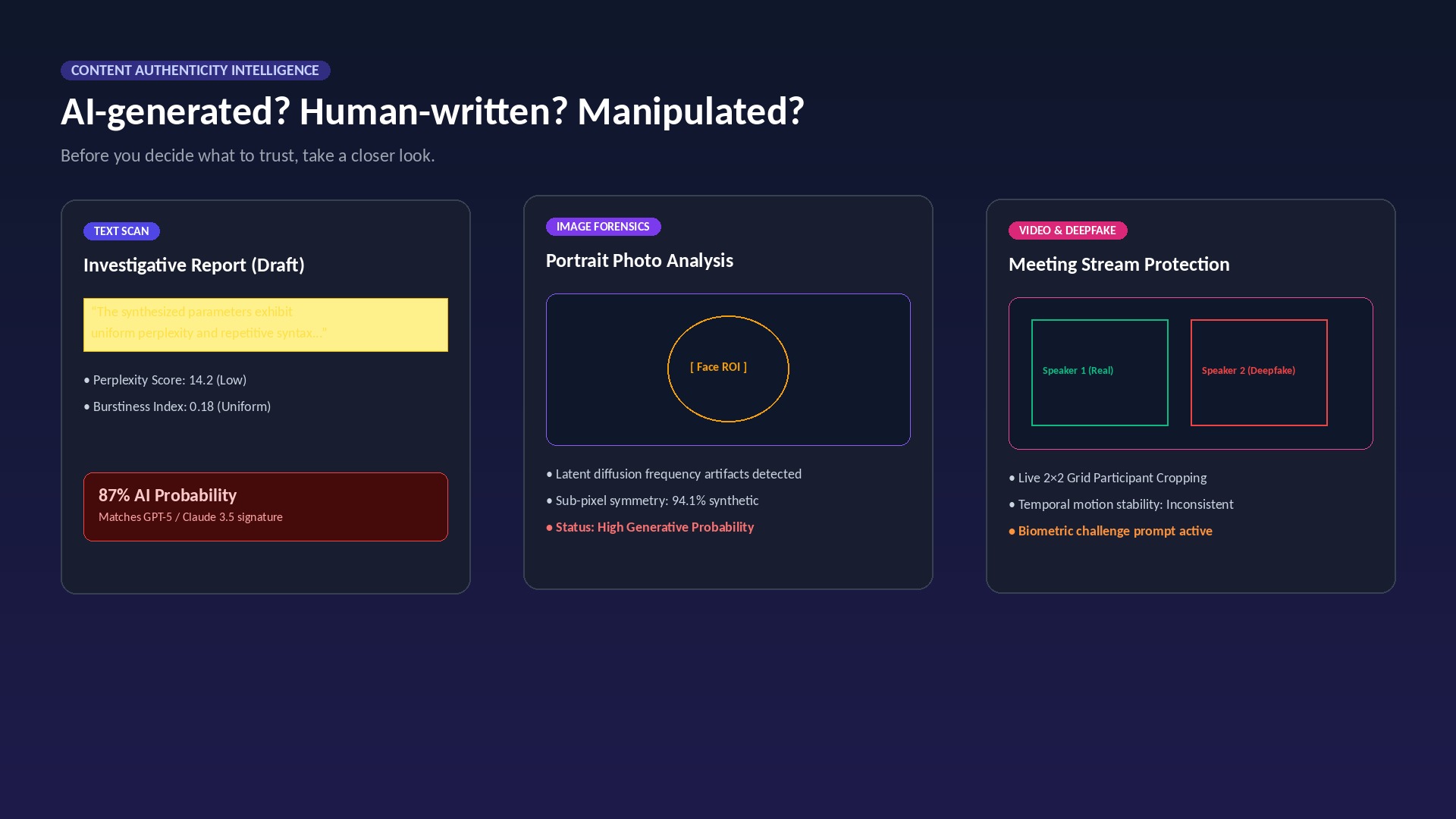
See Which Sentences Look AI-Generated
Document-level scores give you an overview, but sentence-level AI detection lets you inspect individual passages rather than relying exclusively on a single percentage. The full detector page shows a colour-coded breakdown of which sentences carry the strongest AI-like signals.
Passage-by-Passage Breakdown
Rather than relying on a single document-level percentage, sentence-level AI detection highlights individual passages so you can see exactly which parts of the text look most AI-generated.
Mixed-Authorship Visibility
When a document mixes human and AI writing, a global score alone can be misleading. The AI sentence detector surfaces the contrast between sections, giving you better evidence for judgment.
Paragraph-Level Context
Signals are grouped by paragraph as well as sentence, so you can identify patterns across larger blocks of text — useful for longer essays, reports, and articles.
Can This AI Detector Detect ChatGPT?
Yes — AIDetector.cx is designed to analyze patterns associated with machine-generated writing, including text produced by generative systems such as ChatGPT, Claude, and Gemini. Rather than matching against a database of known outputs, the detector examines linguistic and statistical signals in the writing itself — things like sentence structure, vocabulary distribution, and stylistic consistency — that tend to differ between human and AI-generated text.
Because these models share broadly similar training approaches and generation mechanisms, patterns learned from one model are often indicative of others. That said, AI detection is probabilistic: the result is an estimate of how likely a text is AI-generated, not a definitive proof of which model produced it or whether a specific individual used AI assistance.
Highly polished human writing, edited AI text, or content that has been substantially rewritten may score differently than raw AI output. The Balanced Detector is calibrated to reduce false positives for these cases; the High-Sensitivity mode applies stricter thresholds and will flag more borderline text.
Important: AI detection results should not be used as the sole evidence in academic, employment, or disciplinary decisions. Always combine detection results with human judgment, writing history, and other available context.
AI Content Intelligence, Beyond Detection
A connected set of tools for students, educators, writers, SEO teams, and enterprises.
AI Detector
Dual-mode analysis with Balanced and Aggressive engines for comprehensive AI probability assessment.
Try AI DetectorEssay Studio
Guided academic writing workspace: Plan → Outline → Write → Verify → Improve → Cite → Submit.
Start WritingHumanizer
Refine AI-assisted drafts into natural, human-like text while preserving meaning and tone.
Humanize TextPlagiarism Checker
Scan text for duplication and source similarity to ensure originality.
Check PlagiarismSEO Assistant
Content optimization and readability analysis for search engine visibility.
Optimize ContentAPI & Integrations
Integrate detection and analysis into your own workflows, products, and content pipelines.
View API DocsWho Uses AIDetector.cx?
AI detection built for different workflows — from the classroom to the enterprise.
Students
Check essays, assignments and research drafts before submission. Understand how your writing reads and identify sections that may benefit from more personal development.
Check Your EssayTeachers & Educators
Review writing patterns as one input alongside assignment context and institution policies. Detection results indicate probability — not proof of misconduct.
Educator WorkflowWriters & Publishers
Verify AI-assisted and mixed-authorship content before publication. Make informed editorial decisions based on sentence-level signals.
Verify WritingSEO & Marketing Teams
Audit content pipelines for AI signals. Pair detection with the SEO Assistant to review AI probability and search optimisation together.
Audit ContentResearchers
Investigate AI-assisted writing patterns across sample sets using dual-mode results and sentence-level analysis as research data points.
Start AnalysisBusinesses & Enterprises
Scale AI content analysis via the API. Content governance, compliance screening and integration into editorial or knowledge-management workflows.
Explore the APIAI Detection for Every Type of Writing
Different workflows need different perspectives. Here is how AIDetector.cx supports each one.
AI Detector for Students
Check how your essays, assignments and research drafts read before submission. Understanding where your writing sits on the AI-to-human spectrum can help you identify sections that may benefit from a more personal voice or additional development.
Check an EssayAI Detector for Teachers
Review writing patterns as one input alongside assignment context, classroom observation, and your institution's academic integrity policies. Detector results indicate probability, not proof — they should not be used as standalone evidence of misconduct.
Explore Educator UseAI Writing Detector for Editorial Teams
Verify AI-assisted and mixed-authorship content before publication. Run drafts through the AI writing detector to understand where human and AI contributions intersect and make informed editorial decisions.
Detect AI WritingAI Content Detector for Content Teams
Audit content pipelines for AI-generated text to maintain editorial quality and consistency. Pair detection with the SEO Assistant to review content for both AI signals and search optimisation in a single workflow.
Review ContentAI Essay Detector for Academic Research
Investigate AI-assisted writing patterns across sample sets. Use dual-mode results and sentence-level signals as one data point in broader studies on AI writing behaviour, disclosure, and detection methodology.
Start AnalyzingScalable AI Content Analysis
Run AI content analysis at scale through the API or platform. Suitable for content governance, compliance screening, and integration into existing editorial, publishing, or knowledge-management workflows.
Explore the APIBuilt for Responsible AI Verification
Our goal is to give you transparent, explainable signals — not a definitive judgment.
Dual Detection
Two independent engines help you understand the range of possible classifications for the same text.
Multilingual Analysis
Language-aware detection with explicit status and calibration for supported languages.
Sentence-Level Evidence
Inspect individual sentences and paragraphs flagged as AI, human, or mixed.
Mixed-Content Detection
Identify text that combines human and AI contributions rather than forcing a binary answer.
False-Positive Awareness
Clear messaging that highly technical, formal, or polished human writing can trigger detectors.
Privacy-Conscious Analysis
Text is analyzed for detection purposes; no unnecessary data is retained or used for training.
AI detection is probabilistic and should not be used as the sole evidence for academic, employment, or disciplinary decisions. Always combine results with human judgment, context, and other evidence.
Learn More About AI Detection
Guides, research, and comparisons to help you use AI detection responsibly.
Guides
Educational content about AI detection, scores, and best practices for educators and writers.
View all guidesResearch
Original benchmarks, detection methodology, and language-specific performance studies.
View all researchComparisons
Feature breakdowns and use-case comparisons with other AI detection products.
View all comparisonsUnderstanding AI Detector Accuracy
No AI detector can be 100% accurate. Here is what the results mean and how to interpret them responsibly.
AI Detection Is Probabilistic
Every result is an estimate of the probability that a text is AI-generated — not a definitive determination. The detector outputs a percentage, not a verdict. The same text could reasonably receive different scores under different calibration models.
False Positives and False Negatives Are Possible
A false positive means human-written text is flagged as AI-generated. A false negative means AI-generated text is not flagged. Formal, technical, or highly edited human writing is more likely to trigger a false positive. Raw AI output that has been heavily paraphrased is more likely to produce a false negative.
Longer Samples Provide Stronger Evidence
Short passages — under 100 words — give the detector little signal to work from and results should be treated with extra caution. Longer, complete documents with consistent style and structure produce more reliable probability estimates.
Heavily Edited AI Text Is Harder to Classify
When AI-generated text has been substantially rewritten, paraphrased, or edited by a human, the original machine-like patterns are disrupted. The result may be a lower AI probability even for text that originated from a language model.
Results Should Be Read Alongside Context
A detection result should not be treated in isolation. Consider the writing history, the author's voice in other documents, assignment context, and whether the topic or register tends to produce formal, structured prose that detectors may flag.
Independent Detectors Can Legitimately Disagree
The Balanced and High-Sensitivity modes use different calibration thresholds. Disagreement between them is expected for borderline text — it reflects genuine uncertainty, not an error in either model. When both modes agree strongly, the evidence is stronger.
What the AI Detector Measures
Every listed capability reflects what the detector actually produces — no marketing claims, no vaporware.
Frequently Asked Questions
Honest answers about how AI detection works, what the results mean, and where the limits are.
An AI detector (also called an AI content detector or AI checker) is a tool that analyzes a piece of text and estimates the probability that it was generated by a language model such as ChatGPT, Claude, or Gemini. It does this by examining statistical, linguistic, and structural patterns in the writing that tend to differ between machine-generated and human-written text.
More questions? Browse our AI detection guides or contact us.
Subscribe to Our Newsletter
Get the latest updates, tips, and insights delivered to your inbox.
We respect your privacy. Unsubscribe anytime.
Ready to verify your content?
Use AIDetector.cx to analyze content, understand AI probability, and make more informed decisions about authenticity.
No credit card required. Free plan available forever.